
Tom Clancy's Rainbow Six Tactics How to Breach in Rainbow Six Tactics
Stack four operators, pick the walls, and spend the one turn you take together.
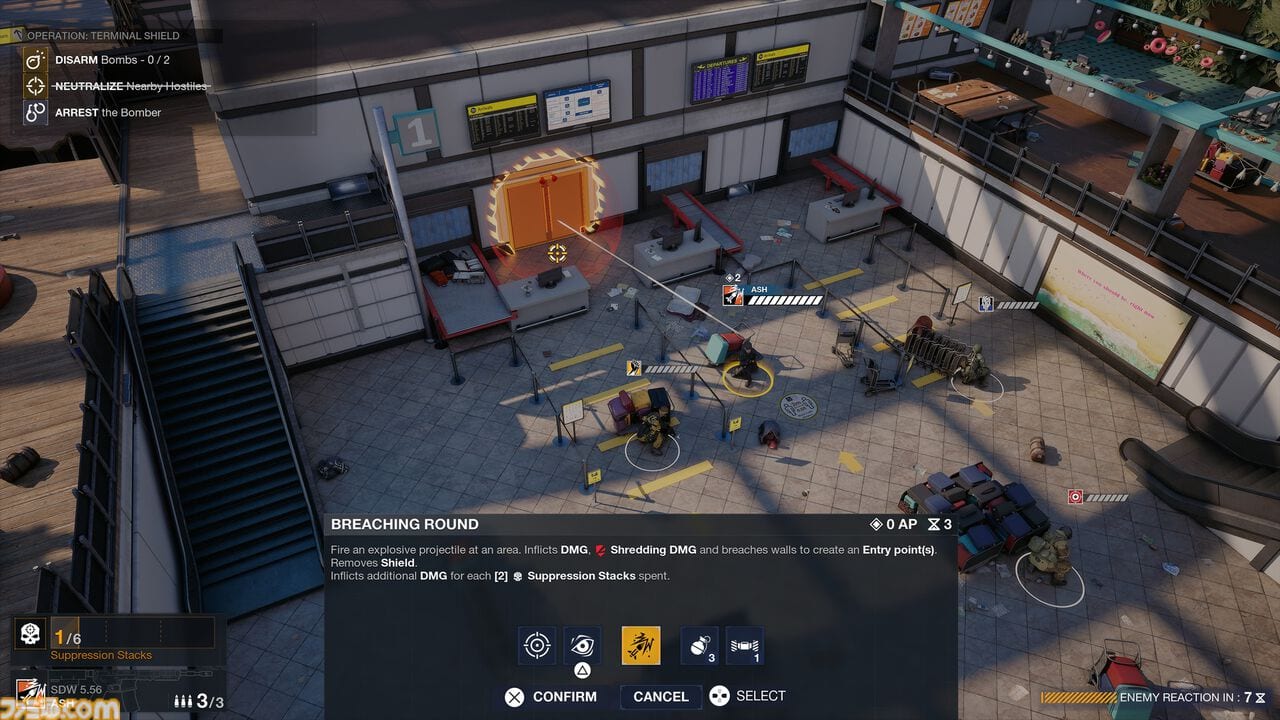
The Breach is why Rainbow Six Tactics does not play like a reskin of XCOM with a rainbow sticker. In a normal tactics game you already lost the first turn: the enemy knows you exist. Tactics gives you a planned, simultaneous opening. Four operators hit a room at once through doors, windows, and walls you chose after drone intel. Then the game becomes turn-based again. If you waste that opening, you are playing a harder tactics game on purpose.
This page is the specialist companion to how to play. Read that for the full loop. Stay here for the assault itself.
What Ubisoft has actually shown
Xbox Wire and GameSpot both describe The Breach as a synchronized assault that breaks the turn rhythm. Operators combine gadgets and destruction in one coordinated beat. The original 1998 Rainbow Six let you draw entry paths on a planning screen. Tactics is the spiritual sequel to that screen, filmed like a Siege highlight.
From the reveal trailer and briefings you can already see:
- Multiple entry types on the same room: hinge, window, and a wall charge.
- A long-range shot (Glaz) timed with the close team.
- A shield operator occupying the fatal funnel.
- Destruction used to create the hole, not only to celebrate it.
What we have not been given: exact action points, whether Breach charges are limited, or how many Breach moments exist per mission. Do not plan a campaign around infinite walls.
Before you commit
Drone the room you will actually enter
A drone that maps the wrong floor is worse than no drone. Confirm the objective, the number of hostiles who can see the entry, and whether a hostage sits on the wall you want to delete. Mission types change this math. A bomb site can tolerate a loud wall. A hostage sitting against that wall cannot.
Assign one job per operator
Four people, four jobs. If two operators do the same job, you left a job empty.
| Slot | Job | Confirmed examples |
|---|---|---|
| Entry | Open the space | Ash, Sledge |
| Intel / disrupt | Disable or reveal | Twitch, drones |
| Anchor | Own the doorway | Montagne |
| Closer | Objective or precision | Glaz, Doc, Finka, Zofia, Nøkk |
The remaining six operators on the 15-person roster are unconfirmed. Do not invent them. Use the confirmed operators page and leave slots flexible in the squad planner.
Pick complementary holes
Two holes on the same wall give the enemy one spray angle. Offset entries — opposite walls, a window plus a door — force split attention. That is Siege site-take logic applied to a tactics clock.
During the Breach
The fantasy is simple: everyone moves at once. The discipline is harder.
- Do not send four bodies through one door. That is a highlight-reel wipe.
- Have someone watching the flank the drone did not love.
- Time the precision shot with the noise. Glaz should fire when heads turn toward the explosion, not two beats later.
- Keep the shield in the funnel, not in the kitchen behind the team.
- If a gadget can die to a shotgun in the first second (Twitch’s bot, a drone), spawn it where the first volley is not.
Think of the Breach as the only time your four-person team gets a free “we all act” card. After that, you are back to spending turns. Waste it on cosmetics and the rest of the map will charge interest.
After the turn clock returns
This is the part players will forget. The trailer ends on the explosion. Your mission does not.
- Re-cover. The hole you made is now a window for whoever shoots next.
- Recount hostiles. A drone pass is stale the moment a roamer walks.
- Spend a turn on the objective, not on a greed kill, if the clock is a bomb or a hostage panic state.
- Call HQ mentally: who is wounded, who is empty on utility, who should sit the next mission. HQ and training is where those bills are paid.
IGN’s interview discussed operators dying for good. A hero Breach that trades an operator for a cinematic is a campaign loss even if the room is clear.
Breach ideas by objective
Hostage. Quiet or offset entries. Never delete the wall the hostage is sitting on. Bring a medic. Nøkk-style openings are more valuable here than on a kill mission.
Bomb. Loud is allowed if you own the timer. Bring a disruptor for defender utility and a plan to hold two approaches after the site is open.
HVT / eliminate. Glaz and a hard breach can end a mission in the opening if intel is honest. If intel is not honest, you just announced yourselves to a building.
These three patterns are expanded in mission types and in the squad compositions tier.
Practice plan for the Closed Test
When the Closed Test lands, do not try to “main” one operator. Run the same map three times with three Breach plans: all loud, mixed, and delayed. Write down which plan spent fewer turns after the opening. That notebook will beat any pre-launch tier list when the real action economy is public.
The Breach is Rainbow Six’s handshake. Learn it, and the rest of Tactics is a tactics game you already understand.
Frequently Asked Questions
Quick answers to the most common questions.
Is every mission forced to start with a Breach?
Footage emphasizes Breach as the signature open. Ubisoft has not said every interior must start that way. Drone first, then decide.
Can I Breach the same room twice?
Unknown until a playtest. Destruction suggests you can keep opening walls during the turn-based phase even after the big synchronized moment.
Which operators are best for Breach?
From the confirmed nine, Ash and Sledge open, Montagne holds, Twitch disrupts, Glaz punishes. See confirmed operators.
Does Breach use extra resources?
Not published. Play the Closed Test as if charges, grenades, and drone batteries are limited.